
Nautilus is a scalable and expandable architecture that will vastly enhance humanity’s understanding of the Universe: From far-away galaxies through habitable worlds to the dwarf planets in our solar system, Nautilus can provide more data and greater sensitivity, enabling the astronomical community to answer profound questions.
We are working with the broader astronomical community to explore all ideas about how Nautilus can be used.
An Ever-Changing Universe
Time-domain astrophysics
A Galactic Search for Life
One of the most fundamental and oldest questions of science is Are we alone? Modern astrophysical methods allow us to analyze the chemical composition of atmospheres of planets orbiting other stars – all we need is a large enough telescope to collect the light filtering through the atmospheres.
A key science goal of the Nautilus Space Observatory is to carry out a comprehensive search for atmospheric biosignatures in about 1,000 transiting earth-sized exoplanets to measure the occurrence rate of life flourishing on other worlds.
Nautilus will study the atmospheric composition of about one thousand earth-size habitable zone exoplanets to assess the diversity of their atmospheres. This large sample will allow a detailed statistical study of earth-sized exoplanets and the identification of Earth-like planets and non-Earth like yet habitable worlds.
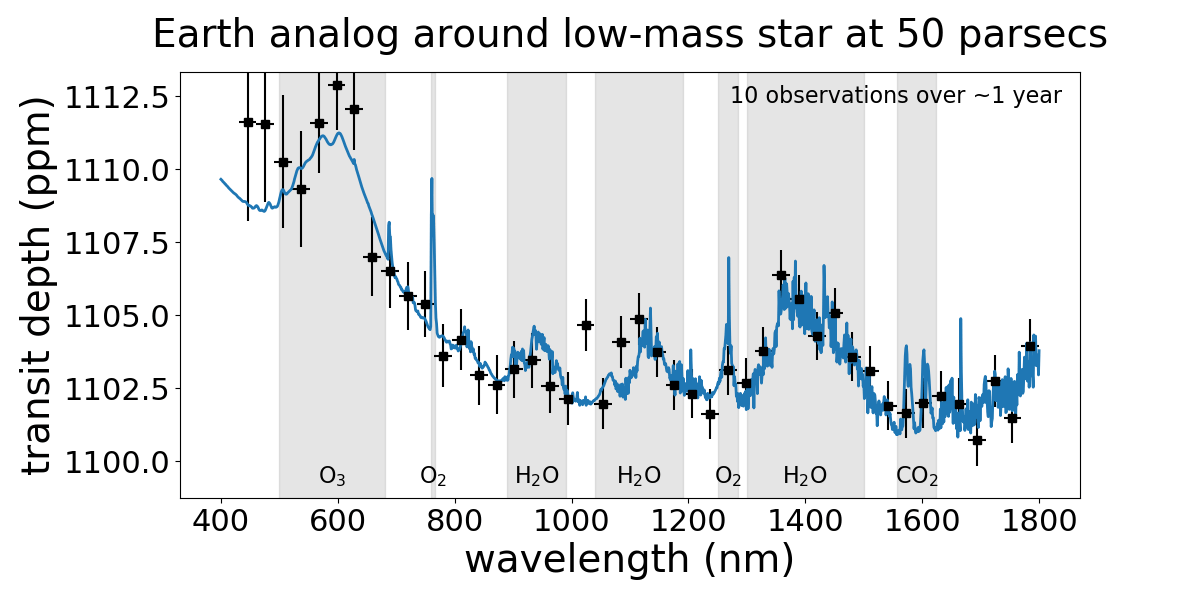
The Nautilus Array will allow the comparison of atmospheric compositions of each planet to the range of atmospheric compositions consistent with abiotic processes. We will identify atmospheres whose composition is not in line with abiotic processes and necessitates the existence of life.
The Nautilus technology will allow orders-of-magnitude increase in sensitivity in exoplanet transit spectroscopy due to the very large collecting area.
Even though over 6,000 exoplanets are known today, no telescope is yet capable of reliably detecting atmospheric biosignatures in any of them. The James Webb Space Telescope is inspecting the atmospheres of a couple of earth-sized planets around the smallest stars in the direct vicinity of the Sun. No existing or currently approved telescope is capable of carrying out a systematic search for life or completing a statistical study of the diversity of earth-like planets.
A multitude of papers have been published about exoplanet science with Nautilus – but these still are just scratching the surface. Let us know about your ideas!